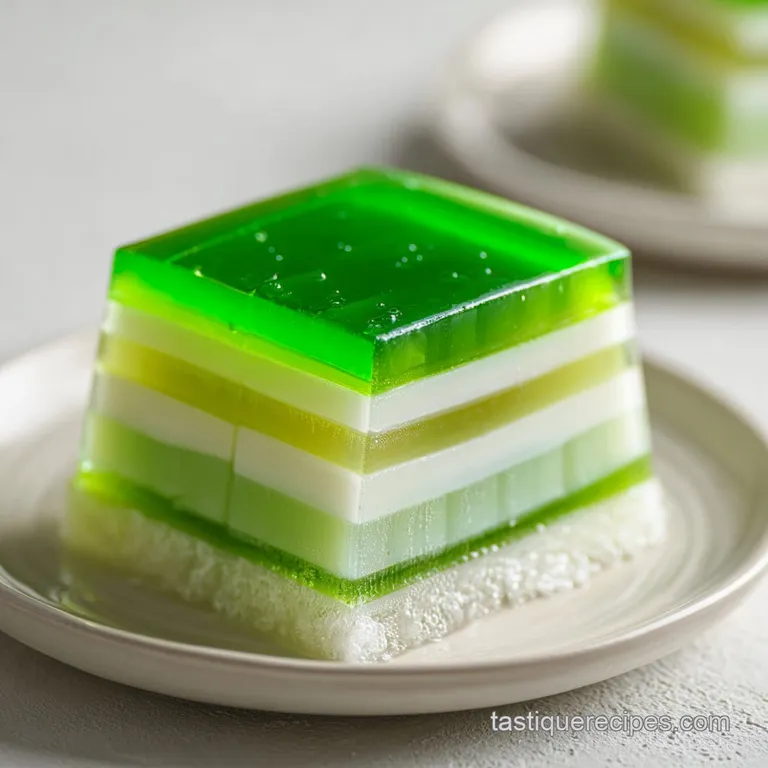
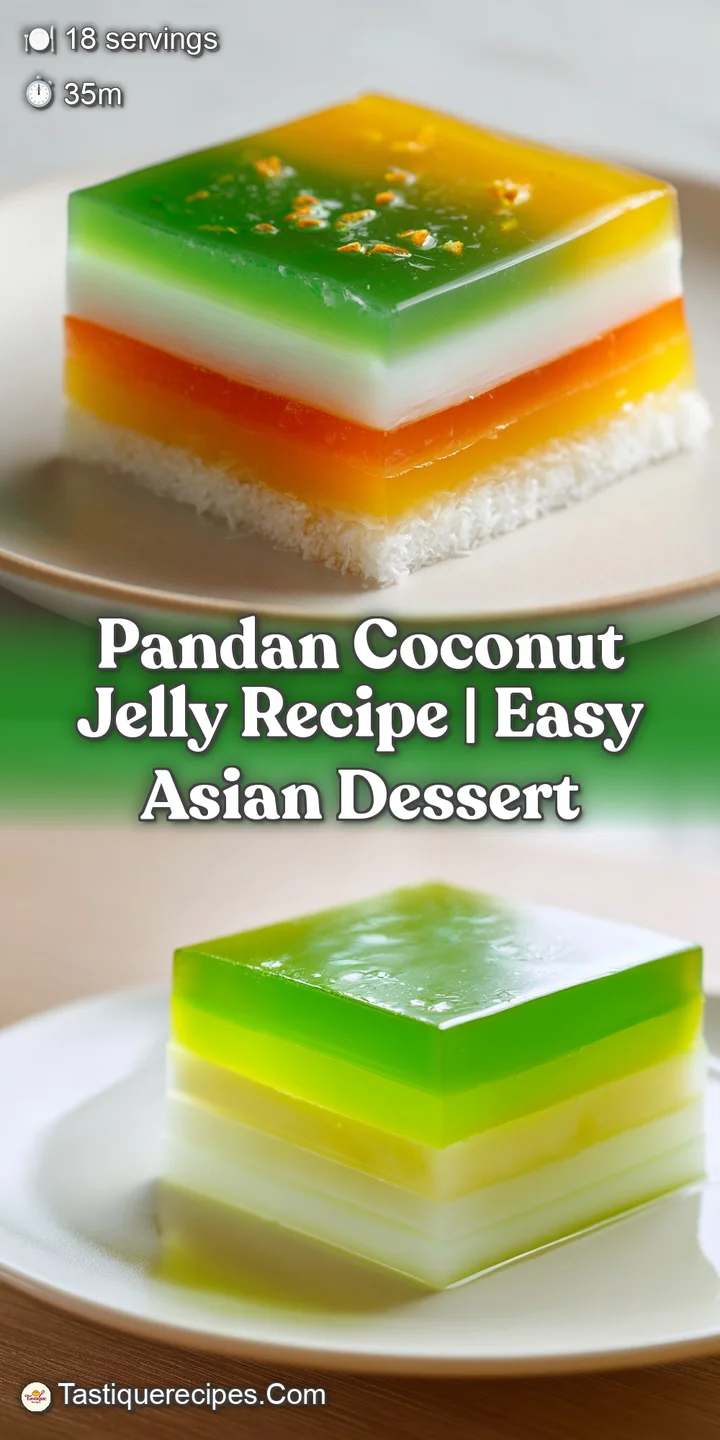
Pandan Coconut Jelly: Bouncy and Aromatic
- Time: Active 15 minutes, Passive 20 minutes, Total 35 minutes
- Flavor/Texture Hook: Bouncy, snap tight texture with a cooling, aromatic finish
- Perfect for: Summer dinner parties, Lunar New Year celebrations, or a refreshing weekend project
- Mastering the Vibrant Layers of Pandan Coconut Jelly
- The Thermal Physics of Layered Agar Bonding
- Critical Metrics for Your Dessert Success
- Curating the Components for Floral Creamy Bliss
- Professional Tools for Sharp Geometric Edges
- Executing the Precision Pour for Striped Perfection
- Identifying and Correcting Common Texture Errors
- Expanding Your Flavor Profile Beyond Tradition
- Preserving the Snap and Freshness of Agar
- Visual Styling for Elegant Restaurant Quality Results
- Recipe FAQs
- 📝 Recipe Card
Mastering the Vibrant Layers of Pandan Coconut Jelly
The first time I tried making this, it was a structural disaster. I was so excited by that specific, heady aroma of bruised pandan leaves filling my tiny kitchen, but I was too impatient.
I poured the white coconut layer over the green base while it was still piping hot, and instead of sharp, clean lines, I ended up with a muddy, swamp colored swirl. It tasted fine, but it looked like a science experiment gone wrong.
I realized then that this Pandan Coconut Jelly isn't just a recipe; it's a lesson in timing and temperature.
When you get it right, the sensation is unmatched. You pull the tray from the fridge, and the jelly has this firm, satisfying snap what I like to call the "agar agar shatter" that's worlds away from the wiggly, soft texture of gelatin.
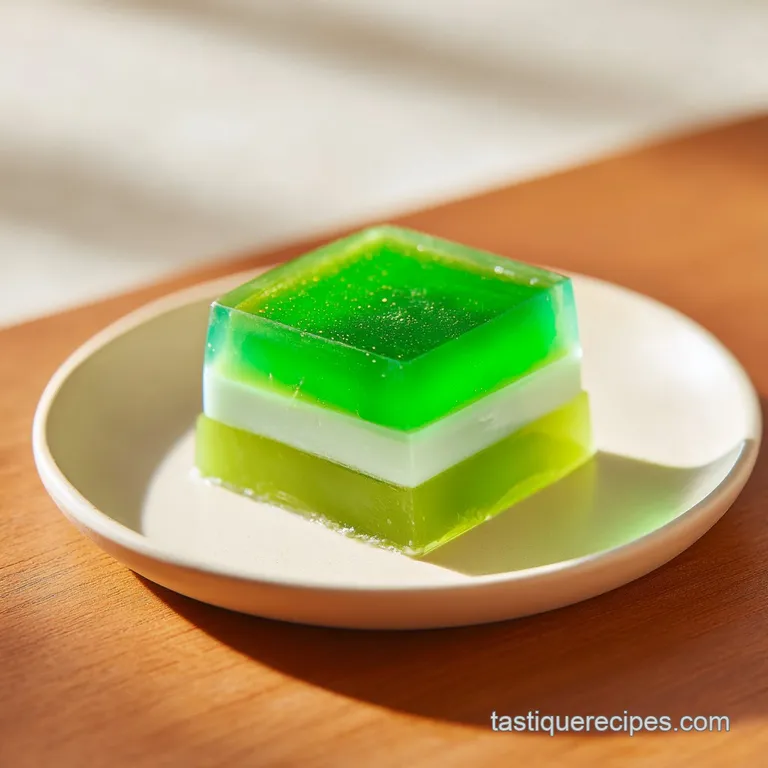
It’s a cooling, bouncy bite that feels clean on the palate, followed immediately by the rich, fatty coat of the coconut milk. Trust me, once you see those distinct green and white stripes through the side of a glass, you’ll feel like a professional pastry chef.
We’re going to walk through the exact checkpoints so you don't repeat my "swamp" mistake.
The Thermal Physics of Layered Agar Bonding
The Tacky Threshold: Unlike gelatin, agar agar sets at room temperature (around 40°C), meaning the first layer must be firm enough to support weight but still "tacky" to the touch to fuse with the second layer.
If the base cools completely and forms a dry skin, the layers will slide apart like tectonic plates when you try to slice them.
| Thickness per Layer | Setting Time | Surface Texture | Visual Check |
|---|---|---|---|
| 1.5 cm | 5-7 minutes | Slightly sticky | Resists light finger pressure |
| 2.5 cm | 10-12 minutes | Tacky but set | No liquid movement when tilted |
| 4 cm | 15+ minutes | Firm skin | Fully opaque and matte |
Finding that sweet spot where the surface is set but not cold is the secret to a unified Pandan Coconut Jelly that doesn't fall apart on the plate. If you find yourself needing a side dish for a larger spread, this Mango Sago Dessert recipe provides a similarly tropical, creamy profile that complements the grassy notes here beautifully.
Critical Metrics for Your Dessert Success
This recipe relies on the specific gelling strength of agar agar powder, which is far more potent than its flake counterpart. We are aiming for a firm, "shatter crisp" texture that holds its shape even at a warm outdoor brunch.
| Component | Science Role | Pro Secret |
|---|---|---|
| Agar Agar Powder | Structural Matrix | Whisk into cold water first to prevent "fish eye" clumps |
| Canned Coconut Milk | Fat Emulsion | Use high fat versions; the fat solids create the velvety mouthfeel |
| Fine Sea Salt | Flavor Contrast | A tiny pinch in the coconut layer makes the sweetness "pop" |
Most people assume all coconut milks are equal, but for this Pandan Coconut Jelly, the water to fat ratio is everything. If you use a "light" version, the white layer will look translucent and watery rather than that opaque, snowy white we want.
Curating the Components for Floral Creamy Bliss
To get that authentic, restaurant quality result, we need to treat our aromatics with respect. Don't skip the fresh leaves if you can find them; the bottled extract is great for color, but the leaves provide the soul of the dish.
- 10g agar agar powder (Pandan Layer)Why this? Provides the firm, bouncy structure typical of Southeast Asian jellies.
- 800ml filtered water (Pandan Layer)
- 150g granulated white sugar (Pandan Layer)
- 10 fresh pandan leavesWhy this? Natural source of the signature vanilla and nutty aroma.
- 1 tsp pandan extract
- 1 drop green food coloring (Optional, for that neon pop)
- 10g agar agar powder (Coconut Layer)
- 400ml high fat canned coconut milkWhy this? Creates the creamy, opaque contrast against the clear green.
- 400ml filtered water (Coconut Layer)
- 130g granulated white sugar (Coconut Layer)
- 0.25 tsp fine sea salt
| Original Ingredient | Substitute | Why It Works |
|---|---|---|
| Fresh Pandan Leaves | Pandan Paste (1 tbsp) | Concentrated flavor. Note: Will result in a darker, more artificial green |
| Canned Coconut Milk | Coconut Cream | Richer, denser white layer. Use 1:1 but expect a much heavier mouthfeel |
| Granulated Sugar | Palm Sugar (Gula Melaka) | Adds deep caramel notes. Note: Will turn the green layer brown |
If you have extra pandan leaves left over, they are absolutely incredible when used to infuse the sponge in a Pandan Chiffon Cake recipe, which uses a similar flavor profile but in a light, airy baked format.
Professional Tools for Sharp Geometric Edges
You don't need a lot of gear, but a few specific items will make your life much easier.
First, grab a 9x9 inch square glass or metal pan. Glass is great because you can actually see the layers building from the side, which helps with the "tacky" check. You'll also need a high speed blender (like a Vitamix or NutriBullet) to pulverize those fibrous pandan leaves.
Finally, a fine mesh sieve is non negotiable. If you leave bits of leaf fiber in your jelly, the texture goes from silky to gritty real fast.
Chef's Tip: Before you start pouring, lightly grease your pan with a neutral oil (like grapeseed) on a paper towel. This ensures those sharp, clean edges when you unmold the Pandan Coconut Jelly later.
Executing the Precision Pour for Striped Perfection
- Extract the essence. Blend 10 fresh pandan leaves with the 800ml water until the liquid is dark green. Note: This ensures the flavor is fully integrated into the water base.
- Strain the solids. Pour the green liquid through a fine mesh sieve into a medium pot, squeezing the pulp to get every drop.
- Hydrate the agar. Whisk in 10g agar agar powder and 150g sugar into the green liquid while it's still cold. Wait until it's clump free before heating.
- Simmer the base. Bring to a boil over medium heat, stirring constantly until the agar is completely dissolved (about 5 minutes).
- Add the punch. Stir in the pandan extract and food coloring, then pour half of this mixture into your prepared pan.
- Prep the coconut. In a separate pot, whisk 10g agar agar, 130g sugar, 400ml water, and 0.25 tsp salt. Bring to a boil.
- Enrich the layer. Once boiling, stir in the 400ml coconut milk. Heat until just simmering but do not let it boil vigorously or the fat might separate.
- The Tacky Test. Check your first green layer. If it feels like the back of a Post it note, it's time.
- The Gentle Pour. Use the back of a large spoon to break the fall of the coconut liquid, pouring it slowly over the green layer to prevent breaking the surface.
- Final Set. Repeat with remaining layers if desired, then let it sit at room temperature for 20 minutes before refrigerating for at least 2 hours.
Identifying and Correcting Common Texture Errors
My Layers Are Sliding Apart!
This is the most common heartbreak. It happens because the bottom layer got too cold and formed a "skin" that won't bond. If you touch the layer and your finger comes away clean and it feels firm like a bouncy ball, you've waited too long.
| Problem | Root Cause | Solution |
|---|---|---|
| Layer Separation | Base layer too cold/dry | Score the surface lightly with a fork before pouring the next hot layer |
| Gritty Texture | Undissolved agar powder | Ensure liquid reaches a full rolling boil for at least 2 minutes |
| Cloudiness in Green | Boiled too long | Keep the simmer gentle once the agar dissolves to preserve clarity |
Common Mistakes Checklist
- ✓ Never add agar agar directly to hot liquid; it will clump instantly.
- ✓ Don't skip the salt in the coconut layer it's the only thing that balances the fat.
- ✓ Avoid using "light" coconut milk unless you want a grey, translucent layer.
- ✓ Always use a spoon to "buffer" the pour so you don't create a hole in the layer below.
- ✓ Do not put the tray in the freezer to speed things up; it ruins the agar's cellular structure.
Expanding Your Flavor Profile Beyond Tradition
If you're feeling adventurous, you can easily swap the flavor profiles while keeping the base ratios the same. The science of the agar stays constant, but the aromatics are your playground.
For a caffeine fueled version, swap the pandan water for a strong, filtered cold brew. The bitterness of the coffee against the sweet coconut is a total "game changer" for brunch. Alternatively, if you want a more floral vibe, replace the pandan with a concentrated tea made from dried Osmanthus flowers, similar to the profile in an Osmanthus Jelly Recipe, which is prized for its clarity and delicate scent.
Scaling the Production
- Cutting the batch (1/2): Use exactly half of all ingredients. Use a loaf pan instead of a square pan to maintain the height of the layers.
- Doubling the batch (2x): Use a large 9x13 inch tray. Note that the middle of a larger tray takes longer to set than the edges, so do the "tacky test" in the very center of the pan.
- Spices and Aromatics: If doubling, you only need 1.5x the pandan extract, as the flavor becomes quite intense in larger volumes.
| Method | Total Time | Texture | Best For |
|---|---|---|---|
| Stovetop (Standard) | 35 minutes | Firm & Snappy | Sharp cubes and traditional plating |
| Microwave (Quick) | 15 minutes | Softer Set | Casual snacks / Small bowls |
| Double Boiler | 45 minutes | Ultra Smooth | Professional grade clarity in green layer |
Preserving the Snap and Freshness of Agar
Agar Agar is a dream for meal prep because it doesn't melt at room temperature like gelatin. However, it does have a tendency to "weep" (syneresis) if left out too long. This is just the water escaping the agar matrix.
To minimize this, keep your Pandan Coconut Jelly in an airtight container in the fridge for up to 5 days.
"Jelly can't be frozen" is a common myth I hear all the time. While you can technically freeze it, the texture upon thawing becomes spongy and wet because the ice crystals break the agar bonds. It loses that signature "shatter" and becomes a bit like a damp sponge. Just make it fresh; it’s quick enough that freezing isn’t worth the quality drop! For zero waste, if you have leftover coconut milk, use it to make a batch of Fluffy Pandan Pancakes the next morning.
Visual Styling for Elegant Restaurant Quality Results
Presentation is where this dish really shines. To get those perfect, sharp cubes, use a very sharp chef's knife and wipe it with a warm, damp cloth between every single cut. This prevents "smearing" the white layer onto the green.
For a more modern look, try using a crinkle cutter to give the edges a ridged texture it catches the light beautifully. If you're serving this at a party, I love cutting them into small 1 inch diamonds and topping each one with a tiny sliver of toasted coconut or a small segment of jackfruit.
The contrast of the bright yellow fruit against the emerald green and snowy white layers is absolutely stunning. Just remember to keep them chilled until the very last second to maximize that refreshing, cooling snap that makes this dessert so addictive.
Recipe FAQs
What is the flavor of pandan jelly?
It tastes floral, nutty, and grassy. Pandan is often described as the vanilla of Southeast Asia, offering a unique, aromatic quality that is light and refreshing.
What does pandan coconut taste like?
It is a balance of bright, floral green notes against rich, velvety cream. The coconut layer adds body and sweetness, preventing the earthy pandan flavor from becoming too grassy.
How to make coconut pandan jam?
Simmer coconut milk, sugar, and agar powder over low heat, stirring constantly. This recipe creates a firm jelly, not a soft jam; for a jam consistency, you must replace the agar with cornstarch or tapioca starch and cook until thickened.
Is pandan jelly good for you?
Generally, yes, when consumed in moderation. Agar agar, the setting agent, is rich in fiber, which aids digestion.
Why did my pandan and coconut layers separate?
The bottom layer cooled too much before the next layer was poured. Agar requires a tacky, but not fully set, surface to bond properly; if the surface is dry, the layers slide apart, unlike the fused structure you achieve if you master the thermal physics of agar setting.
Can I substitute the agar agar with gelatin?
No, you should not substitute agar agar with standard gelatin. Gelatin sets at refrigerator temperatures and results in a wobbly, soft texture, completely missing the desired firm "snap" that is characteristic of this dessert.
What is the best way to ensure sharp lines between the layers?
Pour the second liquid layer very slowly over the back of a warm spoon. This technique breaks the velocity of the incoming liquid, preventing it from digging into or swirling with the set layer below, which is similar to the gentle incorporation technique used when tempering chocolate.
Pandan Coconut Jelly Dessert
Ingredients:
Instructions:
Nutrition Facts:
| Calories | 107 calories |
|---|---|
| Protein | 0.4 g |
| Fat | 4.2 g |
| Carbs | 17.1 g |
| Fiber | 0.8 g |
| Sugar | 15.6 g |
| Sodium | 36 mg |
